Malarkey shingles, installed / File 09
What sits under the shingle
Half the roof is invisible from the day it is finished. This is the half, in the order it goes down.
The deck
Plank, plywood and what tear off reveals
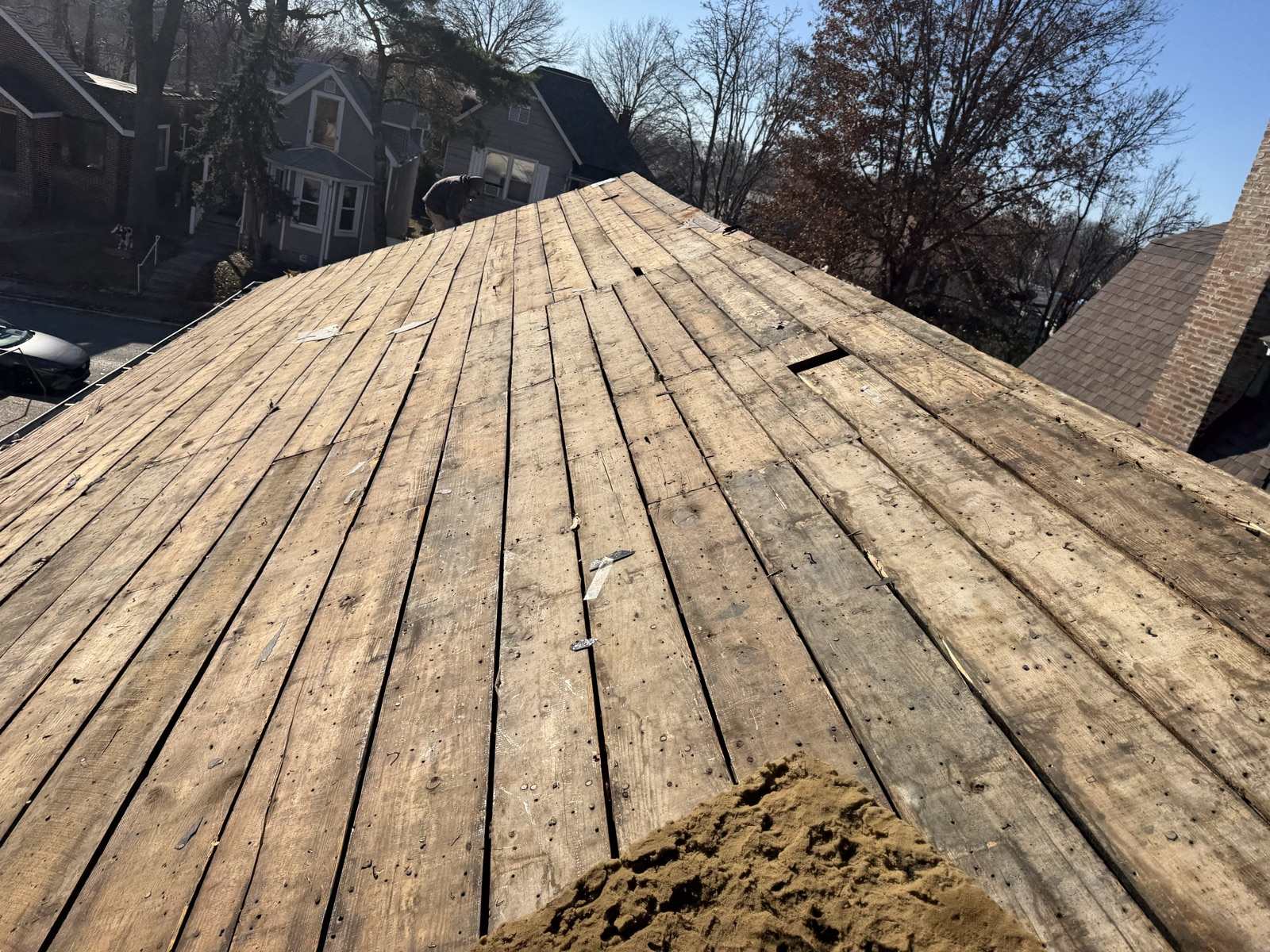
Older St. Louis houses are frequently decked in wide wooden planks laid with gaps between them, rather than in sheet material. That decking is often a century old, and it is usually sound, but it brings three specific issues to a replacement.
- Gaps. A nail driven into a gap between two boards holds nothing. On plank decking a crew has to place fasteners with attention rather than at a fixed pace, and that is a labour cost that shows up in an honest quote.
- Splitting. Old dry planks split along the grain when refastened. Split boards get replaced, and the quantity is unknowable until the roof is open.
- Sheathing over. Where the gaps are too wide or the boards too degraded, the fix is to sheet over the planking. That changes the price, the height of the roof edge at the flashing, and possibly the permit position.
In unincorporated St. Louis County, replacing more than a quarter of the decking is one of the triggers that turns a like for like reroof into permitted work. That is a reason to have the decking conversation before the tear off rather than during it. The permit thresholds are here.
The dry in
Underlayment, membrane and edge
- Drip edge
- Metal at the eaves and rakes that carries water off the deck and into the gutter instead of behind it. Cheap, quick and routinely omitted on older roofs. Its absence is one of the most common causes of rotten fascia in this housing stock.
- Ice and water membrane
- A self adhering bituminous sheet that seals around fasteners. It belongs at the eaves, in the valleys, around penetrations, at sidewalls and on any low slope section. It is the single best defence against the ice dam described on the ventilation page.
- Underlayment
- The field layer over the rest of the deck. Synthetic sheet has largely replaced asphalt saturated felt, and it is tougher underfoot and more stable when a job gets caught by weather overnight. Either is acceptable. Which one, and what grade, belongs on the quote.
- Valley treatment
- Open metal, closed cut or woven. All three are legitimate and they are not equivalent. The valley is where the most water on the roof is concentrated into the narrowest path, so this is not a detail to leave to whoever turns up.
- Starter course
- A manufactured strip at the eave and up the rakes, with its adhesive positioned to grip the first course. Cutting field shingles to do this job saves a small amount of money and gives up wind resistance exactly where wind gets under a roof.
The penetrations
Where roofs actually leak
Almost no roof in this metro fails in the middle of a plane. They fail where something comes through the roof or where the roof meets something else. The list is short and it repeats on nearly every house.
Plumbing vent boots split at the collar, because the rubber has taken fifteen summers of ultraviolet and rubber is not a lifetime material. Furnace and water heater flues need a storm collar and a properly sealed base. Step flashing behind a chimney or up a sidewall gets face sealed with roofing cement by somebody unwilling to open the masonry, and cement is a maintenance item that fails on a schedule. Skylight flashing kits get reused past their life. Satellite dish mounts get screwed straight through a good roof and left there.
The material argument that runs through this site is real, and it is still second to this list. A polymer modified, impact rated shingle over an unflashed sidewall is an expensive roof with a leak in it. Anybody selling you the first while ignoring the second is selling the wrong thing.