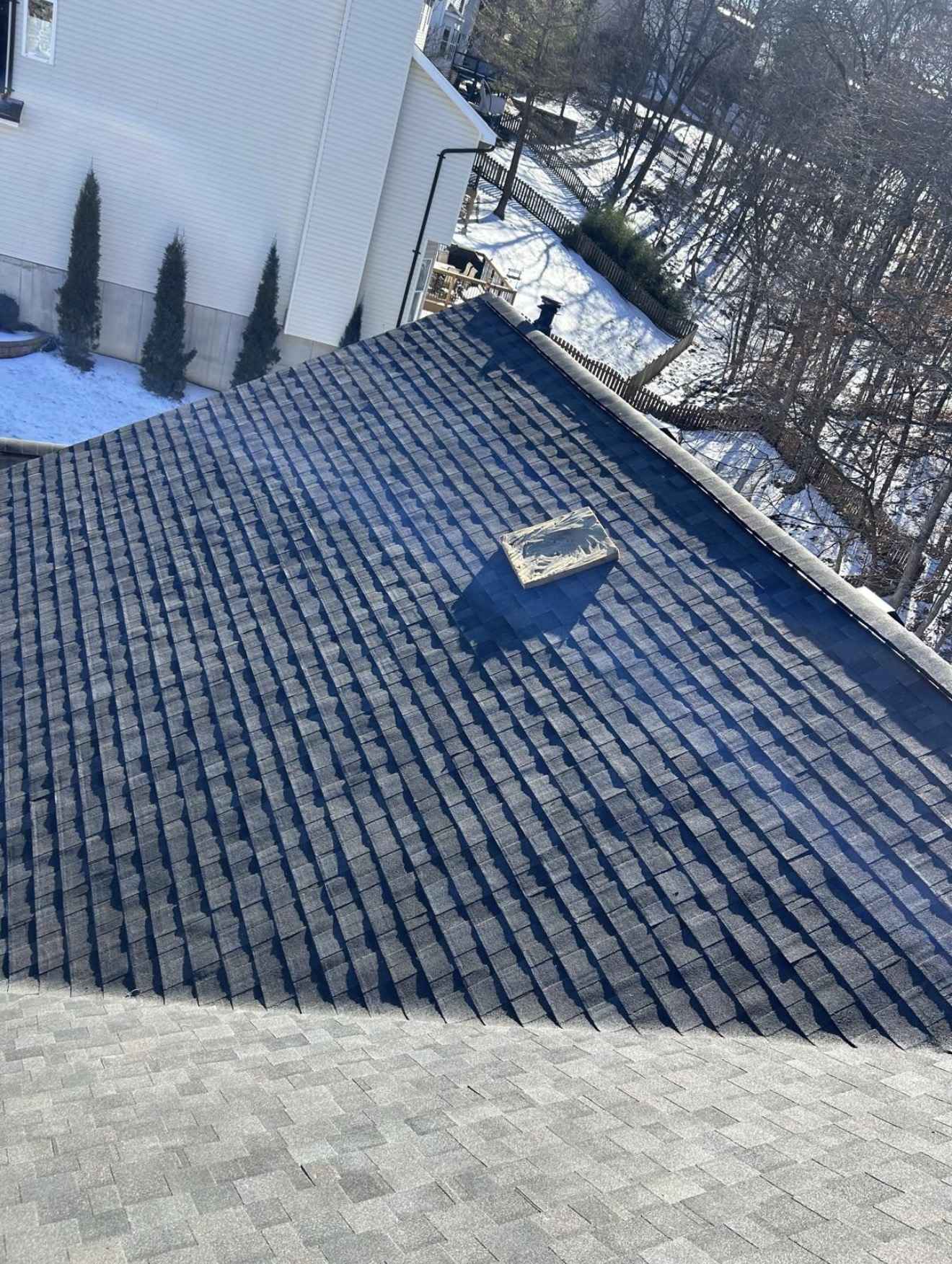
Malarkey shingles, installed / File 02
What rubberised asphalt actually is
A shingle is four thin layers and one chemical decision. This page is about the decision.
The stack
Four layers, drawn out
Before the difference makes sense, the object has to. An architectural or laminate asphalt shingle is not a slab of anything. It is a thin fibreglass web with asphalt coated on both faces, mineral granules pressed into the weather side, and a second cut layer laminated on to build the stepped shadow that makes a roof look like a roof rather than a tarpaulin.
-
- Granule surface
- Crushed mineral, coloured and ceramic coated, pressed into the hot coating. It is the sunscreen. Granule loss is not cosmetic: it exposes the asphalt underneath to ultraviolet, and that is the beginning of the end of a shingle.
-
- Coating asphalt, top
- The layer that decides how the shingle behaves in cold and under impact. Oxidised asphalt is hard and gets harder. Polymer modified asphalt has a rubber elastomer blended through it and stays comparatively elastic.
-
- Fibreglass mat
- The reinforcing web the whole shingle is built around. It carries the tear strength and it is what the nail has to hold on to. A crack that reaches the mat is a failure, which is why the impact test looks at the back of the sample and not just the front.
-
- Coating asphalt and back surfacing
- The underside coating, the sealant strip that bonds each course to the one below it once the sun has warmed it, and a fine parting material so the bundle does not weld itself together in a warehouse.
Everything anybody argues about lives in the second row of that diagram. The mat is much the same across the industry. The granules are much the same. The lamination is much the same. The coating asphalt is where products actually diverge.
The conventional route
Oxidised asphalt, and why it hardens
Asphalt as it arrives from a refinery is too soft to sit on a roof in a St. Louis August. The traditional fix is oxidation: hot air is blown through it, the chemistry rearranges, and it stiffens into something that holds granules, resists flow on a slope and takes a nail.
The trade is stiffness for brittleness, and it does not stop at the factory. Oxidation continues slowly on the roof, driven by heat and ultraviolet, so an oxidised shingle is marginally harder every year it is up there. Two consequences follow. In the cold, a hard asphalt has very little give, so an impact that a warm shingle would absorb becomes a fracture. Over time, the same hardening is what turns a shingle that used to flex under a boot into one that snaps when a repair crew tries to lift a course to slide a new one in.
None of that makes an oxidised shingle a bad product. Most roofs in this county are oxidised asphalt and most of them do their job for a long time. It is simply the material behaving the way the material behaves.
The other route
Polymer modification, in plain terms
The alternative is to blend a rubber polymer into the asphalt instead of hardening it with air. The polymer family used for this in roofing is styrene butadiene styrene, an elastomer, and it is the same approach used to modify bitumen in commercial roofing membranes and in road surfacing. The polymer forms a network through the asphalt, and the result behaves less like a hard shell and more like a tough elastic skin.
Two properties follow, and they are the entire practical case for the material. The first is low temperature flexibility: the coating stays bendable at temperatures where an oxidised coating has gone glassy. The second is impact recovery, which is the useful one. Struck by a stone, an elastic coating tends to deform and come back rather than fracture through to the mat. In a market that logs a hundred and twenty five hail events in a county in six years, which of those two behaviours your roof has is not a trivial question.
Hardness resists a scratch. Elasticity survives a blow. They are not the same property and a roof is asked for the second one.
Whose claim
What the manufacturer publishes, and what we do not
Attributed, not asserted
The manufacturer publishes its own account of its polymer modified asphalt, including its own trade name for it, its own laboratory figures for flexibility and impact, and separate claims about recycled content and about granules said to react with airborne pollutants. Those are that company's published claims about its own products. Keys Roofing has not tested them, does not repeat them as findings of its own, and has no commercial or contractual relationship with that company beyond buying material. If a specific figure matters to your decision, read it in the manufacturer's current literature and note the date on it, because product specifications are revised.
What Keys can speak to is the part it does with its own hands: how the material handles on a cold morning, whether the sealant strip bonds when the sun finally reaches that plane, how it cuts, how it takes a nail, and how it looks when somebody comes back to it three winters later for an unrelated repair. That is craft observation, not laboratory data, and it is marked as such wherever it appears on this site.
The limits
Four things the polymer does not do
- It does not make a roof hail proof. Nothing does. A large enough stone at a high enough speed will bruise or split any asphalt shingle made, and the failure mode of a rubberised shingle under a severe strike is a bruise you have to feel for rather than a crack you can see, which makes an inspection harder rather than easier.
- It does not repair a bad installation. Fasteners in the wrong place, a missing starter course, unflashed sidewalls and an attic with no intake ventilation all fail exactly as fast under a good shingle as under an average one.
- It does not extend anything indefinitely. Ultraviolet, heat cycling and granule loss still govern the end of a shingle's life. The polymer changes how the material behaves under impact and in cold. It does not switch off ageing.
- It does not decide your insurance outcome. That is a matter for your policy and your carrier, and it is dealt with on the insurance page rather than here.
If the material is worth a premium to you, it is worth it for a narrow and specific reason: in a metro that gets struck in April and freezes in February, a coating that stays elastic is doing something measurable that a coating which keeps hardening is not. That is the argument. It does not need to be bigger than it is.